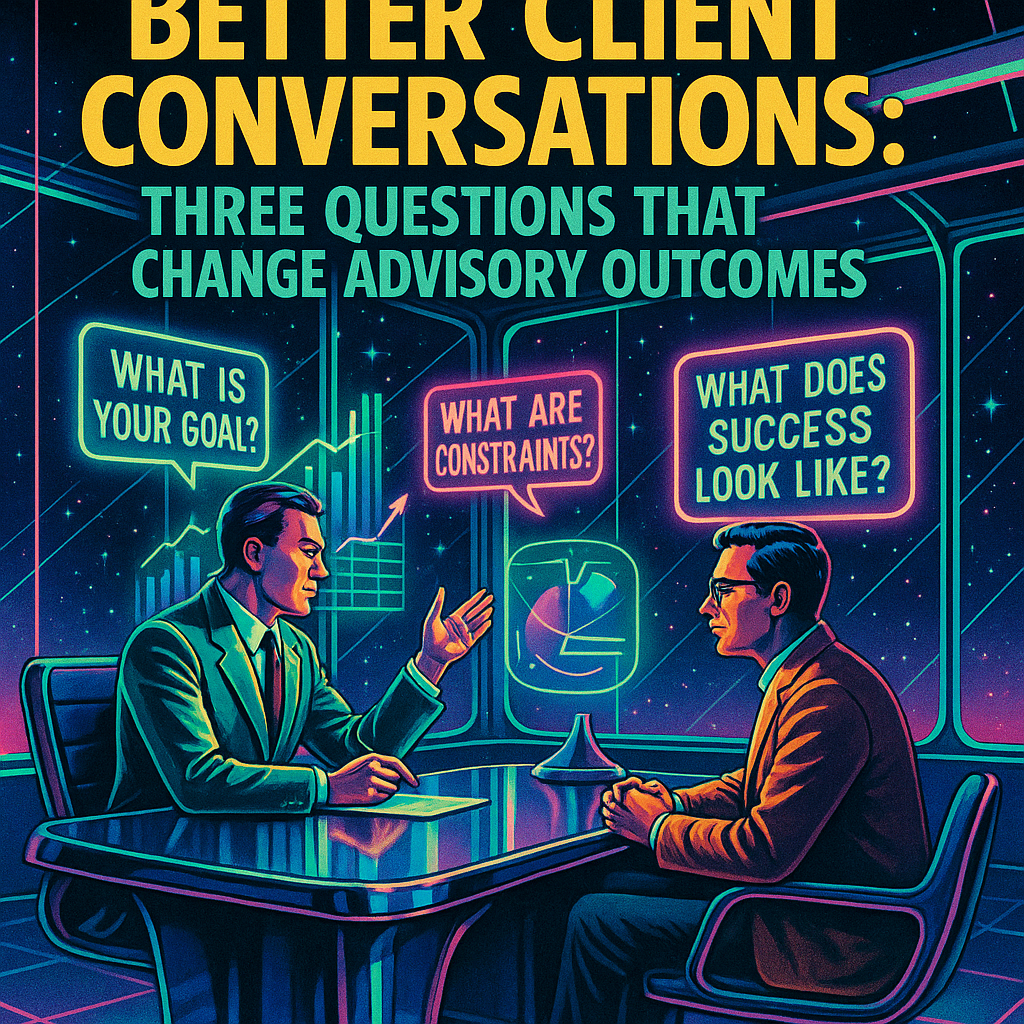
Better client conversations: three questions that change advisory outcomes
When a mid-sized service firm walked into my office with a pile of spreadsheets and a frantic founder, I asked one simple thing: what keeps you awake at night? The founder stared, then admitted not the numbers themselves but the knock-on effects—missed payroll, frantic bill chasing, and losing a key client. That admission changed the whole meeting.
This article shows how to turn routine reviews into conversations that produce decisions. The primary skill is not advanced accounting. It is a disciplined way of asking questions that move clients from data to action.
Why typical reviews fail and how to fix them
Most reviews center on variance reports and ratios. They stay safely technical. They rarely surface the tension between short-term survival and long-term strategy.
When you reframe the meeting around a tangible problem, the numbers become useful. Clients stop defending past choices and start debating trade-offs. That shift is where advisory work adds real value.
Better client conversations start with outcomes, not reports
Open every review by naming the outcome you want to achieve together. Ask: "What would success look like for the next 90 days?" A specific, measurable objective turns vague anxiety into a target.
If the client says "more revenue," follow up: "How much, from which clients, by when?" That forces clarity and surfaces whether the target is realistic given current capacity.
This clarity matters because it changes which metrics matter in the meeting. Instead of rehashing last month’s expense, you focus on lead generation, conversion rates, or margin per client.
Question 1 — What decision do we need to make now?
Treat every metric as a prompt for a decision. Ask the client: "What decisions must be made in the next 30 days to reach the outcome?"
When teams struggle to name decisions, they tend to default to wishful thinking. Your role is to translate data into decisions: hire, pause a product line, renegotiate terms, or refinance a loan.
Make each decision binary and timebound. That forces accountability. If a hiring decision is needed, capture who will interview, the deadline, and the success criteria.
Question 2 — What is the smallest action that moves the needle?
Clients often equate action with major change. Big changes are costly and slow. Ask instead: "What small, testable action could improve our trajectory in two weeks?"
Small experiments reduce emotional friction. A two-week pricing test, a focused sales outreach to five top clients, or a temporary supplier negotiation can reveal direction quickly.
Track the experiment with one clear metric. If it fails, you learn without burning runway. If it works, you scale it with confidence.
Question 3 — What would a stress test reveal about cash and resilience?
No matter the industry, resilient operations hinge on cash. Ask: "Under a 20% revenue drop, how many weeks of runway do we have, and which levers buy us time?"
Walk through realistic scenarios and identify specific levers: stretch payables, temporary pricing changes, or delaying discretionary spend. Linking these levers to lead indicators keeps conversations tactical.
When you need a simple stress-test template for client sessions, use practical resources that map scenarios to actions. For example, a third-party tool on cash flow can speed preparation and make the stress test less theoretical and more actionable. Referencing external frameworks helps keep the meeting focused on outcomes, not spreadsheets. See a useful cash flow resource here: cash flow
Make the meeting structure predictable and short
Standardize reviews into three parts: outcome, decisions, and experiments. Keep them under 60 minutes. Open with the target, review two supporting metrics, then land on decisions and experiments.
Use a one-page meeting brief sent in advance. That reduces housekeeping and forces the client to prioritize. It also prevents meetings from drifting into unfocused analysis.
Closing the loop with simple governance
Turn decisions into visible commitments. Capture them in a shared document and assign owners with deadlines. Review only outstanding commitments at the next meeting.
This governance step separates advisory value from bookkeeping. It makes your conversations catalytic rather than descriptive.
Final insight: conversations build capability, not dependence
The best advisory work leaves a client more capable. By pushing for outcomes, forcing decisions, and favoring small experiments, you help clients develop muscle memory for practical problem solving.
Leadership matters here. Your questions shape behavior, not just reports. If you want to deepen the coaching element of your advisory work, study practical approaches to leadership that help translate strategy into everyday decisions. For a concise exploration of leadership principles worth adapting to client work, see this resource: leadership
Conversations that focus on decisions, experiments, and cash resilience produce clearer choices and faster learning. When you leave a meeting, your client should have one firm decision, one experiment to run, and one named lever to protect runway. That is the difference between a review that feels useful and one that actually changes outcomes.
Leave a Reply