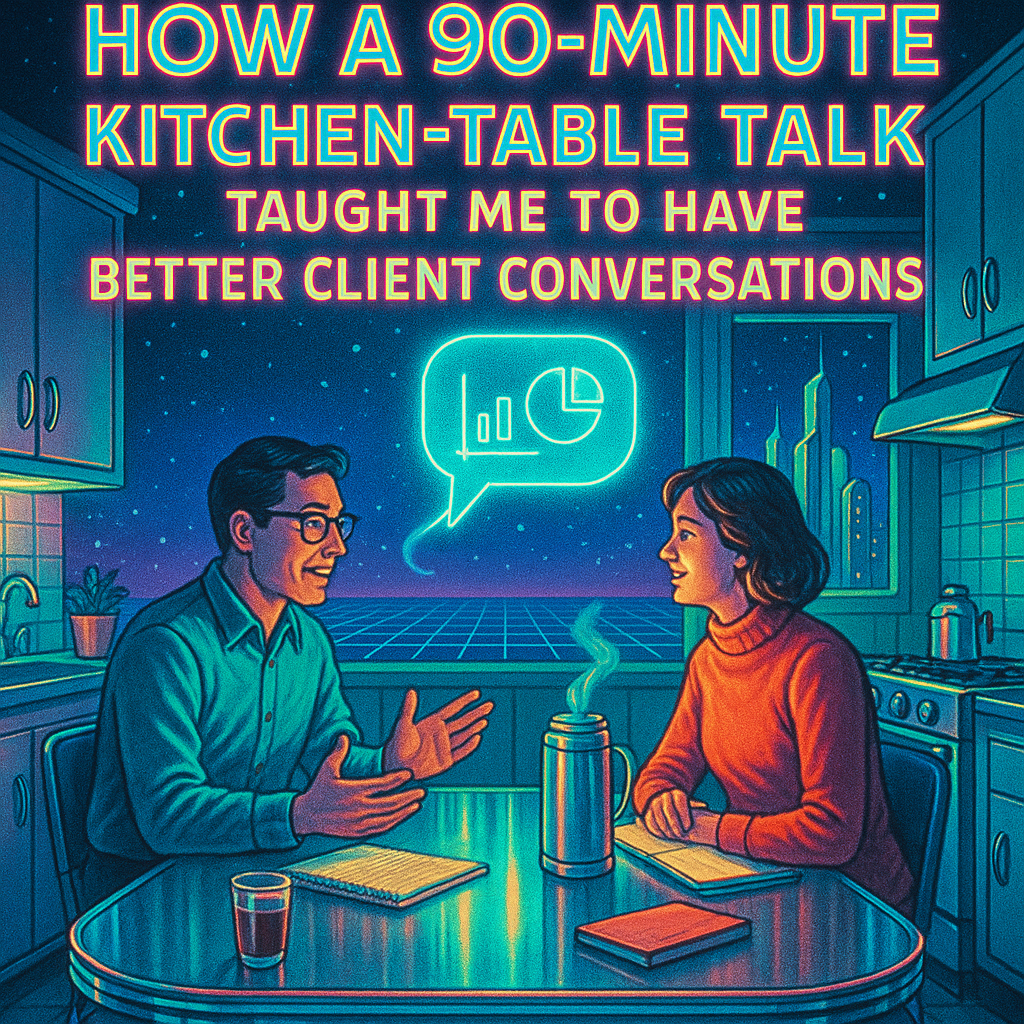
How a 90‑minute kitchen-table talk taught me to have better client conversations
I walked into a client meeting expecting numbers. I left with a plan. That meeting — ninety minutes at a kitchen table, not in a boardroom — taught me a simple truth: better client conversations come from structure and curiosity, not sales scripts.
If you advise small businesses as an accountant, bookkeeper, or business coach, you know how meetings can feel like one‑way traffic. The client asks for a report. You deliver a report. Nothing changes. The story below breaks that loop into repeatable steps you can use tomorrow.
Framing the problem: why most conversations stall
Three years ago I worked with a retailer losing margin and wondering why. The owner brought spreadsheets, diagrams, and frustration. I had tools to analyze pricing and costs. I led with them. She shut down.
The mistake was mine. I treated the meeting as an analysis delivery. I prioritized data over context. Better client conversations start by naming the real problem the owner lives with: unpredictability. Until we addressed that felt problem, no number mattered.
The kitchen‑table method: structure that invites truth
That afternoon I changed course. I sat down, put the laptop away, and asked three plain questions: what keeps you up at night, what would calm that, and what can we test in 30 days? The answers were not elegant. They were actionable.
Use this structure in client sessions:
- Start with a lived problem, not a KPI. Ask one question: what keeps you up at night?
- Translate that feeling into one measurable outcome the client cares about. If it is unpredictability, measure weekly receipts or days of inventory.
- Co-design a 30‑day experiment. Small, time‑bound tests create momentum and reduce defensiveness.
In the retailer's case the owner agreed to a 30‑day pricing test on three product lines and a daily till check at close. We tracked results on a one‑page dashboard she could read in two minutes.
Practical tools: what to bring that actually helps
Bring three simple artifacts to every client meeting: a one‑line agenda, a one‑page dashboard, and a one‑page test plan. Keep the dashboard to one metric the client cares about. Use plain language, not accounting shorthand.
A one‑page test plan should state hypothesis, action, owner, measurement, and review date. That plan flips the meeting from passive to active. It also makes it easier to show quick wins and to spot when problems are systemic.
When the retailer saw a 7% margin improvement on the tested lines in two weeks, her posture changed. Numbers became evidence, not sermons.
How to handle resistance in the room
Resistance often hides behind statements like “we don’t have time” or “we tried that before.” Treat resistance as data. Ask what happened last time, who owned the action, and what would make it realistic now. Often the answer is weaker governance, not lack of ideas.
If you detect fear of change, reframe the test as a learning exercise with a defined end date. That reduces perceived risk and keeps the client accountable.
Getting leadership and cash concerns into the same conversation
Better client conversations need to link strategy to survival. For many owners, leadership is not an abstract trait; it is how they make decisions under pressure. When a client struggles to decide, point them to simple decision rules: stop–start thresholds, review cadence, and an escalation path. If you want a concise guide on practical decision design, reviewing resources on modern small‑business leadership can be useful; it helped me clarify examples for owners (see leadership).
At the same time, map any experiment back to the cash line. A daily till check or a weekly unapplied receipts review converts strategy into liquidity terms. If an owner needs to see immediate benefits, show how the 30‑day test affects working capital. That concrete link between action and survival keeps conversations honest about priorities and helps you defend tradeoffs when they arise around spending or hiring. If you want a practical template for translating actions into working capital outcomes, keep a simple rolling forecast that focuses on inflows, outflows, and the single number most likely to change: available cash (see cash flow).
Follow‑through: the secret to credibility
The meeting is not the work. The follow‑through is. Schedule the 15‑minute check two weeks out and a 45‑minute review at 30 days. Use those follow ups to tighten the test, not to restart the conversation.
Practical rules that preserve momentum:
- Use time‑boxed experiments only. End dates force clarity.
- Assign a named owner for each action. No owner, no progress.
- Measure one metric and one qualitative signal. Both matter.
In the retailer’s case the named owner was the store manager. She reported daily. The owner stopped waiting for perfection and started reacting to evidence. That change in rhythm turned the engagement from advisory to operational improvement.
Closing insight: conversations as the intervention
You will not fix everything with a better report. You will change outcomes with a better conversation rhythm. Treat meetings as interventions: diagnose the felt problem, codify a narrow experiment, tie it to cash and decisions, and follow through with short check‑ins.
When you design your next client interaction around those steps you will find more buy‑in, faster results, and a clearer path from advice to impact. That is the difference between delivering numbers and changing a business.
Leave a Reply